

Tinder Reverse Image Search: A Safe, Evidence-First Guide (2026)
A Tinder photo can be checked in more than one way, but no search can certify a stranger. Use exact-image search, public-web face search, source review, platform tools, and first-date safety steps without turning one result into a verdict.
Part of Dating Safety Photo Checks →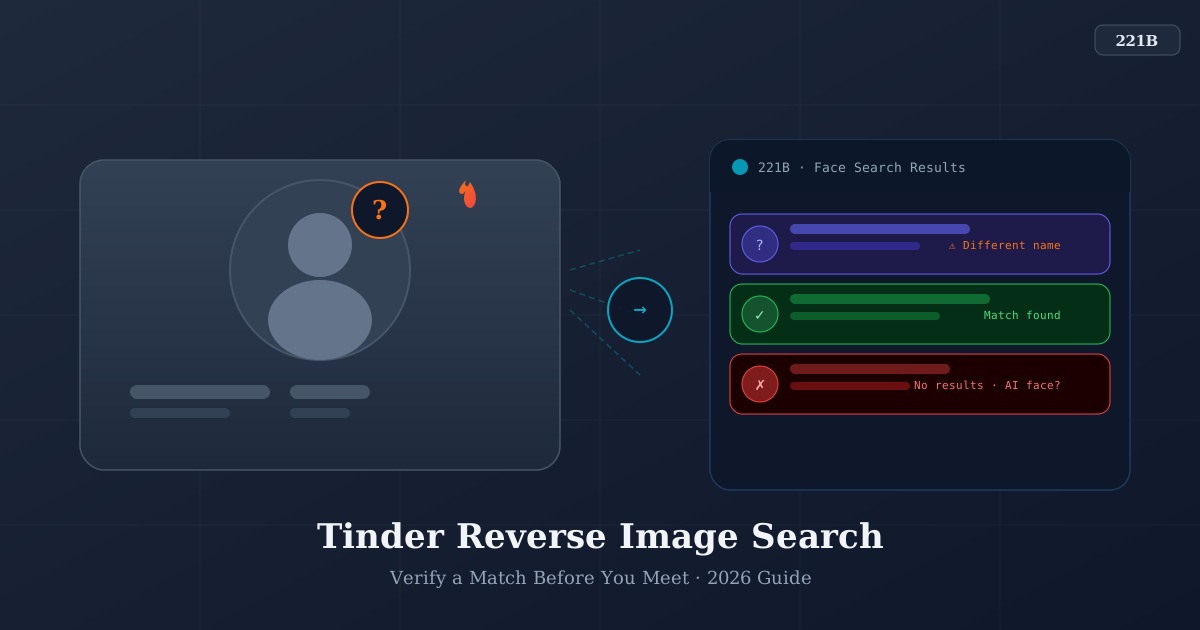
TL;DR: What Is the Safe Short Answer?
A Tinder reverse image search may surface candidate public pages that reuse a photo or show a similar-looking face, but it cannot certify a stranger. Search only images you can legitimately access, compare exact-image and public-web results, open the original sources, and treat every match as a lead. No result is inconclusive, never proof of authenticity.
Ask whether several independent signals support continuing, not whether a tool verified the person. Keep the process proportionate and stop if it feels intrusive or unsafe.
How Do You Save and Prepare a Tinder Photo?
Use a clear screenshot only when the profile is visible to you through normal Tinder use, then crop away names, messages, and other unnecessary personal details. Keep one uncropped copy for exact-image search and one face-focused copy for a face-search tool. Do not access private accounts, defeat controls, or collect photos for surveillance.
- Choose a clear photo. Prefer a forward-facing image without sunglasses, heavy blur, or several people. If a group photo is the only option, do not upload bystanders' faces.
- Take a screenshot. Preserve the whole image for Google Lens because clothing, scenery, and composition can help it locate the same picture.
- Make a separate crop. For face search, include the full face with a little space around the head. Avoid aggressive sharpening or filters that alter the source.
- Remove unrelated details. Crop out chat text, phone numbers, usernames, and other people. Upload the minimum information necessary for the check.
- Use the result for safety review. Do not publish the screenshot, contact unrelated people, or turn a candidate page into an accusation.
A poor input can create poor candidates or no candidates at all. Low resolution, side profiles, masks, strong shadows, image compression, and changed appearance all affect what a search system can retrieve. Retrying with one other profile photo can be reasonable; repeated searching across a person's network is not.
What Can Exact-Image Search Show?
Exact-image search is best for finding copies, crops, and visually related versions of the Tinder photo, plus public pages that contain them. Google explains that image search may return similar images, websites with the image, or the image in other sizes. Those pages can supply context, but they do not by themselves identify the profile owner.
- Open Google's official image-search instructions and choose the camera or Lens option available on your device.
- Upload the uncropped screenshot first. Review “exact matches,” “visual matches,” and pages using the image when those views are offered.
- Repeat with a tighter crop if the interface focuses on the screenshot frame instead of the profile photo.
- Open promising pages rather than trusting thumbnails. Confirm that the photo actually appears and note the page date, owner, and original context.
An exact copy on an older public page may show that the image existed elsewhere first. It still might be the same person reusing their own photo, an authorized repost, a fan page, or misuse by either account. Compare dates and context, then ask a calm question if it is safe to do so.
Google Lens and public-web face search are complementary. Our dating image-search comparison explains the retrieval difference in more detail and helps you decide when the free exact-image step is enough.
What Can Public-Web Face Search Show?
Public-web face search can return candidate pages where a similar-looking face appears in a different photograph, which exact-image tools may miss. 221B searches indexed public-web material; it does not search Tinder's internal data, private accounts, law-enforcement systems, or every page online. A candidate is a starting point for source review, not an identity finding.
- Upload the face-focused crop through the normal 221B search workflow.
- Review several candidates, not just the top thumbnail. Similarity ranking can surface lookalikes, outdated pages, and unrelated people.
- Open each original public page. Check whether the image, page owner, publication date, location, and surrounding text are actually relevant.
- Look for consistency across independent sources. Repeated claims copied from one page are not independent confirmation.
- Stop once you have enough information for your immediate safety decision. Do not map relatives, employers, addresses, or other sensitive details.
The product's methodology page explains that 221B presents candidate matches for user review. Coverage changes as public pages appear, disappear, block crawlers, or sit outside an index. That is why the responsible output is “candidate pages found” or “no candidate pages found,” never “identity verified.”
Public availability does not remove the need for restraint. Use a search to decide whether to continue a conversation or take a safety step, not to expose, follow, threaten, or contact someone shown on an unrelated result page.
Before paying for a specialist tool, compare free and one-time PimEyes alternatives by search type and source access. The free saved 221B report lets you inspect one example without signup or uploading a photo.
How Should You Read Matches and No Results?
Read every outcome as limited evidence: an exact-image match shows reuse, a face candidate shows resemblance, and no result shows only that the searched system returned nothing useful. None of these outcomes proves who controls the Tinder profile. Compare original sources, dates, context, live interaction, and platform signals before choosing a proportionate next step.
| Search outcome | What it supports | What it does not prove | Proportionate next step |
|---|---|---|---|
| The exact photo appears on an older page | The image was publicly used there by that date | Who copied whom, or who controls either account | Open the source, compare context, and ask a neutral question if comfortable |
| A similar face appears under another name | A candidate page deserves review | That the two people are identical or that deception occurred | Check several photos and independent sources; do not contact the candidate |
| Sources look broadly consistent | Some public claims align | Safety, intentions, relationship status, or a complete identity | Continue normal platform and first-date precautions |
| No useful result appears | The tool found no useful indexed candidate | That the person is real, fake, private, safe, fraudulent, or AI-generated | Use other signals or pause; never force a conclusion |
Image quality, edits, privacy settings, crawler access, a small public footprint, a new photo, and index coverage can all affect retrieval. The same limits apply when checking whether a dating photo may be synthetic; our AI dating-photo guide combines provenance and behavioral evidence without calling an empty search a detector.
If a page appears to conflict with what you were told, preserve your own safety without escalating. You can slow the conversation, decline a meeting, or use Tinder's tools. A public-web clue is not a licence to accuse, publish personal information, or investigate beyond your legitimate need.
What Do Tinder Verification Badges Actually Mean?
Tinder describes Photo Verification as a video-selfie check used to compare facial geometry with profile photos, while ID + Photo Verification adds a document-based process where available. Tinder also says a verification badge is a signal, not a guarantee that profile information is valid or that a person is safe. Treat it as one platform signal.
The scope matters. A photo badge addresses whether the submitted video selfie resembles profile photos at the time of verification. Tinder's current Photo Verification help page describes the process and notes that verification is optional or market-dependent. It does not promise a complete background check or future conduct.
Where offered, ID + Photo Verification uses ID and face checks, with availability and accepted documents varying by location. Tinder explicitly warns that its process cannot guarantee the validity of a user's identity or anyone's safety. Avoid inventing extra meaning for the badge.
A missing badge is not proof of deception, and a badge does not make an unsafe request acceptable. Keep evaluating behavior, boundaries, money requests, and whether the person respects a reasonable pace.
Which Safety Signals Matter Before a First Date?
A photo search is only one small part of first-date safety; behavior and a practical meeting plan matter more than a tidy set of search results. Look for respectful communication, consistent answers, no pressure for money or sensitive data, and willingness to meet in a public place on a timeline that suits you. Trust discomfort without needing proof.
- Keep early conversation in the app. Tinder can provide reporting and blocking tools there. Be cautious if someone immediately pushes you to another service or sends an unfamiliar “verification” link.
- Never pay to prove you are safe. The FBI's warning on dating verification schemes describes links that collect registration and payment information, then create recurring charges.
- Protect financial and account information. The FTC advises against sending money or gifts to an online romantic interest you have not met, especially by hard-to-recover methods.
- Offer a short video call, not a test. Both people can consent or decline. A declined call may have innocent reasons, but repeated pressure, inconsistent explanations, or anger at a boundary can inform your decision.
- Plan the meeting independently. Choose a populated public venue, arrange your own transport, tell a trusted person, keep your phone available, and leave whenever you want.
Product walkthrough
See how candidate public pages are presented
This walkthrough explains the search and source-review flow. It does not demonstrate identity verification or a safety guarantee.
For Australian readers, the eSafety Commissioner's online-dating guidance covers safer communication, image searches, reporting, and support. Its advice is broader than any search tool: secure your accounts, watch for controlling behavior, preserve evidence when needed, and seek local help if you feel threatened.
What Should You Do If Something Feels Wrong?
You do not need to prove deception before slowing down, ending contact, declining a meeting, or using Tinder's report and block tools. Prioritise immediate safety, preserve relevant messages without distributing private material, and choose the official support channel for your location. Do not confront a suspected scammer, contact a search candidate, or publish an accusation.
- Pause contact. Do not click new links, send more images, reveal your address, or continue a payment. If you are in immediate danger, contact local emergency services.
- Use Tinder's current tools. Follow the Safety and Reporting help centre for the applicable reporting path. Interface labels can change, so use Tinder's live instructions rather than an old screenshot.
- Secure accounts and money. Change exposed passwords, enable multi-factor authentication, contact your bank or payment provider promptly, and ask whether a transfer can be stopped.
- Report fraud in the relevant country. In the United States, the FTC's romance-scam guidance links to ReportFraud. Australian readers can use eSafety's pathways and the official ReportCyber portal as appropriate.
- Seek human support. Tell someone you trust. If intimate images, threats, coercion, or sextortion are involved, use official specialist support rather than negotiating or paying.
Keep the scope humane. A candidate result can involve an innocent person whose image was reposted, an outdated biography, a namesake, or a lookalike. Report the Tinder profile or harmful conduct you experienced; do not recruit others to investigate a person from a thumbnail.
The safest conclusion is often modest: “I do not have enough confidence to continue.” That protects your boundaries without claiming a tool proved fraud, identity, or intent.
Frequently Asked Questions
Can I do a reverse image search on Tinder directly?
Tinder does not provide a public reverse-image search inside the matching interface. If a photo is legitimately visible to you, you can screenshot it and use an external image-search service. Search only what you need, remove unrelated personal details, and review each service's current privacy terms before uploading.
Is it legal to reverse image search someone on Tinder?
Law varies by location, purpose, consent, and what you do with the result. A public-web search is not permission to stalk, harass, expose personal information, or bypass privacy controls. Keep any check proportionate to personal safety, and obtain local legal advice when the stakes or intended use are significant.
Will my Tinder match know I searched their photo?
An external search does not run through Tinder’s matching interface, but notification, logging, retention, and processing practices depend on the service you use and can change. Do not assume a search is private. Read the provider’s current privacy notice, upload the minimum necessary image, and avoid sensitive or intimate material.
What if 221B returns no results for a Tinder photo?
No result means only that the system returned no useful indexed candidate for that input. Coverage, image quality, privacy settings, crawler access, cropping, changed appearance, and a newly posted image can all affect retrieval. It does not prove that a person is genuine, fake, safe, fraudulent, private, or AI-generated.
Does Tinder's blue checkmark mean someone is verified?
It means the profile completed Tinder’s applicable Photo Verification process. Tinder describes the badge as a signal and explicitly says it cannot guarantee identity validity or safety. Availability and process can differ by market. Consider the badge alongside respectful behaviour, consistent conversation, your boundaries, and a safe first-date plan.
Does no result mean a Tinder photo is AI-generated?
No. An empty image or face search is not an AI-image detector. Real photographs can be absent because they are new, private, poorly indexed, edited, or difficult to match; synthetic images can also be reposted publicly. Review provenance, source pages, visual clues, platform signals, and behaviour without treating one clue as proof.
Should I contact a person shown in a candidate result?
Usually no. The result may be a lookalike, namesake, repost, outdated page, or unrelated person. Contact can alarm an innocent person and widen the privacy impact. Review the original source for your own decision, then use Tinder’s report or block tools for the profile and conduct you actually encountered.
What is the safest way to plan a first Tinder date?
Choose a populated public place, arrange your own transport, tell a trusted person where you will be, keep your phone available, and retain control over when you leave. Avoid sharing your home address early. Follow local official guidance, and cancel if pressure, threats, money requests, or your own discomfort emerge.
When should I report or block a Tinder profile?
You can report or block when conduct feels unsafe, deceptive, abusive, coercive, or against Tinder’s rules; you do not need a conclusive face-search result. Use Tinder’s current Safety and Reporting instructions. If money, threats, intimate images, or immediate danger are involved, also contact the relevant official service in your location.
Tags
See the review format and real source links first
Review a sample report before uploading your own photo. The useful output is source-page context, not an automatic identity claim.
View a sample reportRelated Articles
Reverse Face Search vs Image Search for Dating Verification
For dating safety, exact-image search can locate copied photos while public-web face search may surface candidate pages across different photos. Neither verifies identity.
🧭How to Tell If a Dating Profile Photo Is AI-Generated (2026)
A careful, evidence-led workflow for checking whether a dating profile photo may be AI-generated without treating one visual clue, search result, or badge as proof.
🕵️♀️How to Check If Someone Is Real Online: 9 Safer Steps
A practical nine-step guide to checking if someone is real online through behavior, exact-image search, candidate public pages, source review, and an optional video call—without treating any clue as identity proof.
🧭How to Detect Catfishing Safely with Face Search (2026)
A safety-first workflow for checking a suspected catfish using behavior, exact-image search, candidate public pages, platform tools, and official reporting channels.