

Military Romance Scams: How to Check Stolen Soldier Photos Safely
A safety-first guide to military romance scam photo checks, official claim verification, evidence preservation, and reporting without accusing the person pictured.
Part of Dating Safety Photo Checks →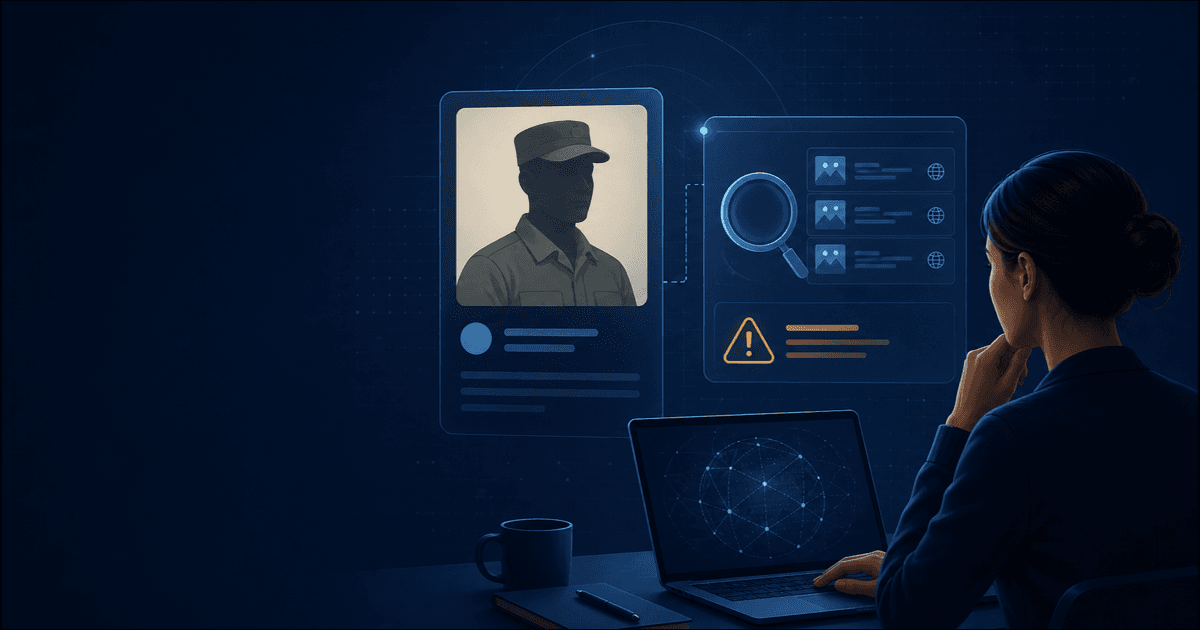
TL;DR: What Should You Do First About a Military Romance Scam?
If someone claiming to be a service member asks for money, stop the payment. Preserve the messages, contact the payment provider, and report the account. You do not need to identify the operator before protecting yourself. The person pictured may be another victim whose name and photos were copied.
A military romance scam uses a claimed service identity and an online relationship to seek money, information, account access, or intimate images. The safest first decision comes from the request and conduct, not from whether a search can identify a face.
The US Federal Trade Commission’s current romance-scam advice says scammers may claim to be in the military or working far away. The story can explain why they cannot meet. The FTC recommends reverse image search and notifying the app or site. It also advises reporting to ReportFraud and contacting the payment company promptly if you sent money.
Do not send more money, cryptocurrency, gift cards, passwords, one-time codes, identity documents, or intimate images while you investigate. If you face an immediate physical threat, contact local emergency services. If intimate images or threats are involved, the Australian eSafety Commissioner’s online-dating guidance provides specialist safety and evidence-preservation steps.
What Is a Military Romance Scam, and Whose Photos Are Being Used?
A military romance scam uses a false online relationship and a claimed service identity. The goal may be money, information, images, or financial help. Official US sources say scammers often copy real service members’ names and photos. Evidence of impersonation does not show that the person pictured committed fraud.
The US Army’s social-media safety page explains that scammers use service members’ photos to create false identities. It tells people to preserve screenshots of money requests or impersonation and report the false account to the platform. The pictured person can therefore be a target of misuse as well as a stranger to the conversation.
Military Consumer is a US government consumer-education program. It warns that imposters copy names and pictures from real service members. It recommends searching the image and the claimed name with words such as “scam” or “imposter.” Stop contact if the online love interest asks for money.
Keep four questions separate:
- Is the account’s conduct safe? A harmful request can answer this without a name.
- Was this exact photo reused? Exact-image search may find copies and dates.
- Are there candidate public pages with the same-looking face? Face search may find leads, not identity proof.
- Who operates the profile? A photo search usually cannot establish this.
Do not contact the service member shown in a candidate page, their family, employer, or unit. Report the account and conduct you directly observed. Publishing a suspected identity can expose an unrelated or already-impersonated person to further harm.
Which Military Money Stories Conflict With Official Army Guidance?
Money requests for leave, secure communications, marriage permission, early retirement, medical care, transport, food, or housing conflict with current US Army guidance. Treat official-looking forms as unverified. Open government sites yourself. Documents, uniforms, email addresses, badges, or video supplied by the profile are not proof on their own.
The US Army’s imposter-scam FAQ states that soldiers and their loved ones are not charged the listed fees. Its guidance is US-specific; readers elsewhere should open the relevant defence or consumer-protection authority rather than assuming another country uses identical processes.
| Claim from the profile | What the US Army says | Safer action |
|---|---|---|
| “Pay for my leave or transport home” | Soldiers do not pay to take leave, and the Army does not charge families to transport a soldier home. | Do not pay; save the request and report the account. |
| “Buy secure military communications” | The Army does not charge soldiers or families for secure communications. | Do not follow supplied links or transfer instructions. |
| “Pay for marriage permission or early retirement” | Those claimed fees are not required. | Open the Army FAQ directly and stop the payment. |
| “Cover my medical care, food, or housing” | The Army provides medical care, food, and housing support for deployed soldiers. | Treat the money request as a safety signal, not a puzzle to solve. |
Can an email address or ID settle the question?
No. A personal address does not disprove service, and a .mil address is not a complete identity or safety check. The Army FAQ says its scam examples should trigger stopping contact and official reporting. An email address alone still cannot show who controls the dating account.
Do not ask for a military ID, Social Security number, unit location, deployment details, family information, or credential photo. That creates new privacy and security risks. It still does not show who controls the dating account.
How Can You Check Whether a Soldier Photo Was Stolen?
Start with the exact profile image in a conventional reverse image search. Use public-web face search only if different public photos could help. Open every candidate source. Compare names, dates, and context. Record conflicts without contacting, accusing, or publishing information about the person shown.
Use the least intrusive useful search
- Preserve the profile first. Save its URL, handle, relevant messages, dates, and the image as it appeared. Keep only what you need for reporting.
- Use the least sensitive image. Do not upload intimate images, identity documents, screenshots containing financial details, or photographs obtained through bypassing privacy controls.
- Run an exact-image search. Follow Google’s official search-by-image instructions. Results may include similar images and websites containing the same or a similar image.
- Open the original pages. Compare publication dates, captions, names, occupations, and whether the page itself looks authoritative. A thumbnail or repeated repost is weak evidence.
- Ask a narrower follow-up. If a different public photo could materially help, a bounded face search may surface candidate pages. Review the difference between exact-image and face search first.
- Write a limited finding. Record the source and date or note a conflict. Do not write “this is the scammer” or “the profile is real.”
A candidate can be a lookalike, old page, repost, or misuse. 221B surfaces candidate public-web pages for manual review. It does not access private accounts, platform data, military databases, or law-enforcement systems. Its methodology and interpretation limits explain why resemblance scores rank leads rather than prove identity.
For a saved screenshot on a Google, Samsung or other supported phone, use the privacy-aware Android reverse image search workflow before considering a face-focused search.
Stop when conduct already gives you a safe decision. Also stop when the source is clear enough to report, the evidence stays unresolved, or more searching would collect needless information. Do not turn a safety check into ongoing monitoring.
What Can a Photo Search Result Prove — and Not Prove?
A matching page is a lead for manual review. It is not proof of identity or fraud. An empty result is also inconclusive. The photo may be new, private, synthetic, edited, poorly indexed, or outside tool coverage. Review the request, story, account history, and original sources before deciding what to do.
| Search outcome | What it may support | What it cannot establish | Next step |
|---|---|---|---|
| Same photo on an older public page | The file or a close copy appeared elsewhere by that date. | Who copied whom or who controls the current profile. | Save the source URL and report the observed reuse. |
| Similar face under a different name | A candidate source deserves comparison. | That either name is correct or the pictured person is involved. | Check dates and context; keep the conflict unresolved if needed. |
| Many copies of one image | The image is widely reused. | Multiple independent confirmations of identity. | Group duplicates and rely on the earliest credible source. |
| No useful result | Only that this search returned no reviewable public lead. | Authenticity, safety, absence from the web, or complete coverage. | Return to behavior and official reporting; do not escalate searching by default. |
Search tools cover different public pages and update at different times. Private or access-controlled profiles may not be available at all. That is why a no-result outcome is not reassurance, while a result is not a verdict. The broader online-contact safety guide combines behavior, direct communication, platform tools, and public evidence without requiring certainty.
Do not show search candidates to a crowd and ask people to identify or confront someone. If a public source is relevant, preserve the link for the platform, bank, or official report. The goal is to document the account and request you experienced, not to expose a person from a photograph.
Which Profile and Conversation Signals Matter Besides the Photo?
The strongest warnings are behavioral and financial. They include urgent money requests, pressure to move off-platform, repeated excuses not to meet, isolation from family, and requests for intimate images or financial details. A uniform, badge, video clip, official-looking form, or polished profile can still be copied or fabricated.
The FBI’s romance-scam guidance advises people to research the photo and profile, go slowly, ask questions, and be wary when someone quickly asks to leave the dating service, isolates them from friends and family, requests inappropriate material or financial information, or repeatedly promises to meet but cannot.
Scamwatch’s relationship-scam guidance for Australia likewise identifies rapid emotional attachment, movement to messaging services, requests for money or personal details, and isolation as risks. Its advice is to stop sending money, contact the bank, change exposed passwords, report, and speak with someone trusted.
- Money or value: cash, crypto, vouchers, gift cards, device purchases, parcel fees, or receiving and forwarding funds.
- Account access: passwords, verification codes, remote access, bank details, or identity documents.
- Secrecy and isolation: instructions not to tell family, the bank, the platform, or authorities.
- Manufactured urgency: a deadline, emergency, travel problem, or threat that prevents independent checking.
- Sexual coercion: pressure for intimate images followed by threats, payment demands, or claims that paying will end the harm.
You can stop because one of these requests violates your boundary. You do not have to continue contact to gather proof, arrange a test, trick the account, or expose an operator. A video call can add context but cannot guarantee account ownership, intentions, or future safety.
How Should You Save Evidence and Report a Military Romance Scam?
Save the profile URL, handle, messages, dates, payment instructions, receipts, phone numbers, and relevant screenshots before blocking. Contact the platform and payment provider. Then use your country’s official reporting route. Do not repost photos, crowdsource an identity, or contact a military unit with deployment details found online.
Preserve only what the report needs
- Stop new exposure. Send no more money, codes, documents, or images. Change reused passwords and enable multi-factor authentication on affected accounts.
- Contact the payment provider. Use the phone number or app you normally use, explain the suspected fraud, and ask whether the transaction can be stopped or traced. Recovery is not guaranteed.
- Preserve evidence proportionately. Save what the report needs. Do not access accounts or private data without permission.
- Report the account in-platform. Report the profile and conduct you experienced, not an assumed real-world identity.
- Use the correct national channel. Open the current official page. Reporting options and emergency numbers differ by region.
| Region | Current official route | Important limit |
|---|---|---|
| United States | FTC ReportFraud and, for internet-enabled crime, FBI IC3. | Call local emergency services for immediate danger. |
| Australia | Scamwatch for scam intelligence and ReportCyber for cybercrime. | Scamwatch says its form is not an official police report; call 000 for immediate danger. |
| United Kingdom | Report Fraud provides the England, Wales and Northern Ireland route; Scotland uses Police Scotland. | Follow the current regional directions shown on the official page. |
| Canada | The Canadian Anti-Fraud Centre links the national reporting system and advises contacting local police. | The agency recommends reporting even when no money was lost. |
If someone threatens to share intimate images, do not pay or redistribute them. Use platform reporting and specialist image-abuse support. In Australia, eSafety can help. Elsewhere, open your national cyber-safety or victim-support service directly.
How Can You Help a Loved One Without Blaming Them?
Lead with concern, not accusation. Ask whether the account requested money, identity documents, financial access, or intimate images. Suggest checking the story together through official sources. UK Report Fraud says victims are not to blame. Trust makes it easier to pause payments and report safely.
Start with observable events: “I noticed the request for a transfer and I’m worried,” rather than “You are being foolish” or “That person is fake.” A shame-based confrontation can push someone away from the support they need. Offer to sit with them while they call the bank, preserve messages, or use the official reporting form.
Agree on a short pause before any new payment or disclosure. During that pause, compare the claimed military process with the official source, run the least intrusive photo check, and ask the platform for help. Keep the question practical: “What action is safest given what we know?”
If the photo belongs to a real service member, remember that they may have no connection to the account and may already be dealing with impersonation. Our guide for people whose photos are being misused explains why reporting the observed account is safer than directing strangers toward the person pictured.
The same separation matters in commerce. If a face appears beside a suspicious listing, use the Facebook Marketplace listing and payment checklist to review the item and transaction without treating the photo as proof about the account operator.
Public-source walkthrough
See how candidate pages are reviewed
This walkthrough demonstrates source review. It does not access military or private records, identify an account operator, or prove whether a profile is safe.
Success is not a public identification. It is a safer outcome: the payment is paused, evidence is preserved, exposed accounts are secured, official reports are filed, and uncertainty is left visible. If the story remains unresolved but the conduct is unsafe, that is enough reason to end contact.
Frequently Asked Questions
Does a .mil email prove someone is a soldier?
No. A .mil address can be one supporting detail. It does not prove who controls the dating profile, that an email is genuine, or that the conversation is safe. Do not rely on a supplied address alone. Compare claims through official sites, and stop on money or credential requests.
Does no reverse-image result mean the military profile is real?
No. A missing result means only that the search returned no useful public lead. The image may be new, edited, private, synthetic, poorly indexed, or outside that tool’s coverage. Return to the profile’s behavior, official military guidance, and reporting options. Do not treat silence as reassurance.
Should I contact the service member shown in a search result?
Usually not. The pictured person may be unrelated, a lookalike, or another victim of photo misuse. Contacting them, their family, employer, or unit can spread the harm and expose sensitive information. Preserve the source URL, then report the profile and conduct you directly observed to the platform and authorities.
Where should I report if I already sent money?
Contact the bank, card issuer, exchange, or payment service immediately through its official channel and ask whether the transfer can be stopped. Then report the account to the platform and use your country’s official fraud or cybercrime route. Recovery is not guaranteed, but prompt reporting preserves options and evidence.
Can 221B access military records or private accounts?
No. 221B surfaces candidate pages from the public web for manual source review. It does not access military, law-enforcement, government, private-account, or platform-internal databases. A candidate result, resemblance score, or missing result cannot establish legal identity, account ownership, honesty, fraud, or safety.
Tags
See the Source-Review Workflow Before You Search
Open the saved zero-credit case study to see how candidate public pages, uncertainty, and stopping rules are presented before deciding whether another photo check is necessary.
Open the 0-Credit Case StudyRelated Articles
How to Check If Someone Is Real Online: 9 Safer Steps
A practical nine-step guide to checking if someone is real online through behavior, exact-image search, candidate public pages, source review, and an optional video call—without treating any clue as identity proof.
🧭How to Detect Catfishing Safely with Face Search (2026)
A safety-first workflow for checking a suspected catfish using behavior, exact-image search, candidate public pages, platform tools, and official reporting channels.
💘Reverse Face Search vs Image Search for Dating Verification
For dating safety, exact-image search can locate copied photos while public-web face search may surface candidate pages across different photos. Neither verifies identity.
🛡️Someone Is Using My Photos: Find the Fake Profiles (2026)
Worried someone is using your photos for a fake profile? A 2026 step-by-step guide to finding impersonation accounts with reverse face search, capturing evidence, and reporting them.